
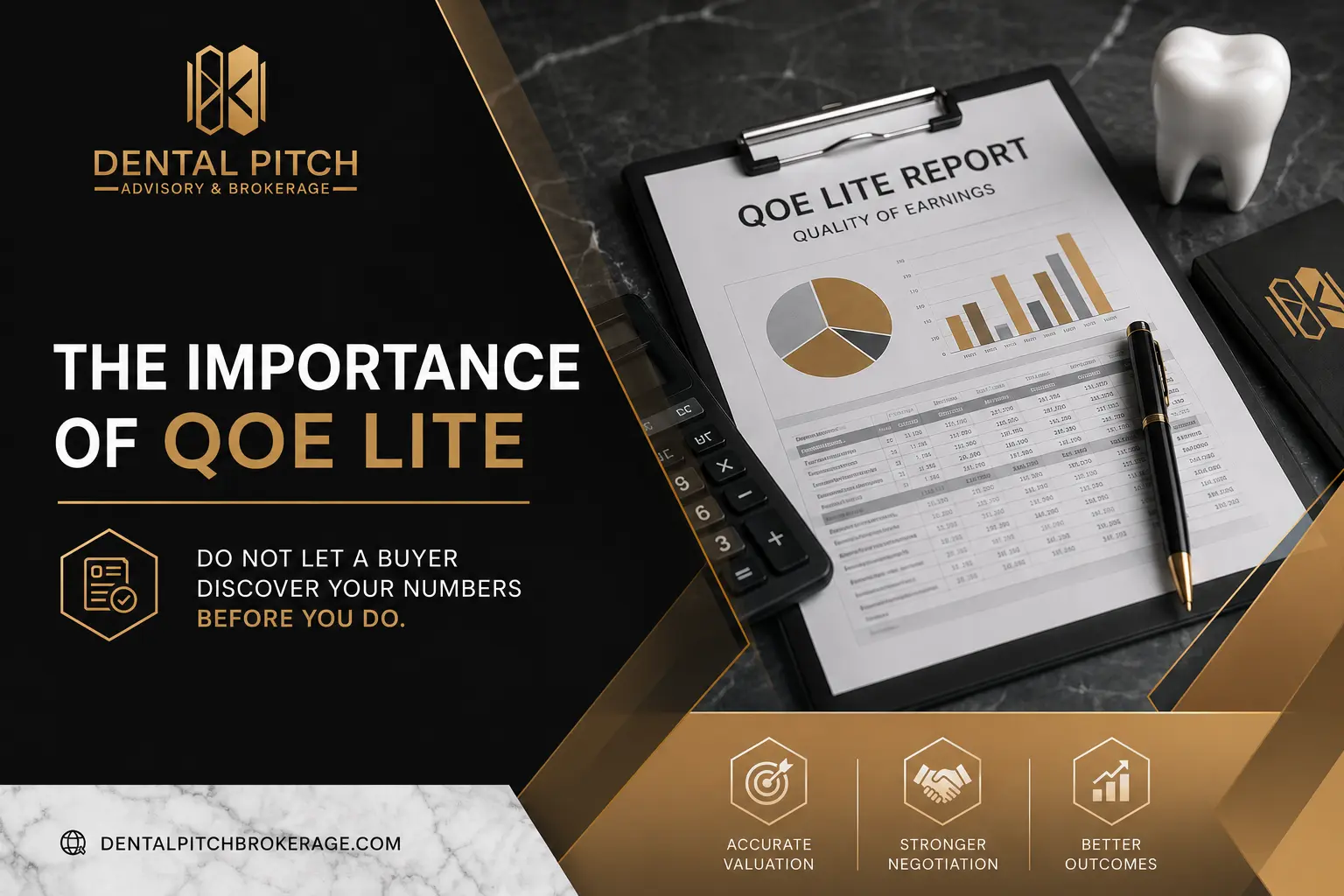
Dental Practice Valuation: Why Sellers Need a QOE Lite Before Buyers Do

- A Quality of Earnings Lite (QOE Lite) uncovers your true adjusted EBITDA before buyers do.
- It strengthens your negotiating position by documenting add-backs and normalizing financials.
- Every additional dollar of EBITDA can increase practice value by 5–8x or more.
- At $2,500–$5,000, a QOE Lite is often one of the highest-ROI investments a seller can make before going to market.
If you are asking, “How much is my dental practice worth?”, the answer should not begin with a guess. It should begin with a clear dental practice valuation process that validates adjusted EBITDA, documents add-backs, reviews expenses, and helps protect your number before buyers conduct their own Quality of Earnings review.
Most dentists spend 20 or 30 years building a practice worth millions of dollars then walk into a sale negotiation without knowing their real number. That is the single most expensive mistake in dental practice transitions. The Quality of Earnings Lite (QOE Lite) exists to fix it.
At Dental Pitch Advisory & Brokerage, we advise every seller we represent to complete a Quality of Earnings Lite before going to market. Not because it is standard practice in the industry because it isn’t. Most brokers skip this step entirely but the buyers aren’t. If you do not know your real numbers before they do, you are negotiating from a position of weakness.
This guide explains exactly what a Quality of Earnings Lite is, what documents are required, why every dollar counts and how much it costs.
What Is a Quality of Earnings Lite?
A Quality of Earnings Lite also called a QOE Lite or LQE (Lite Quality of Earnings) is a specialized forensic accounting report that examines the last three years of your dental practice’s financials to produce an accurate, defensible picture of your true earnings power.
It is not a valuation. It is not a tax return. It is not something your regular CPA produces. It is a structured financial analysis performed by a firm that specializes in dental transactions, designed to do one thing: tell buyers, sellers, and advisors exactly what your adjusted EBITDA really is down to the penny.
In plain language:
A Quality of Earnings Lite tells the market exactly what your dental practice earns, with every legitimate one-time expense and personal add-back identified and supported. It becomes your financial defense when a buyer tries to negotiate your price down.
The “Lite” distinction is important. A full Quality of Earnings includes bank statement matching against every transaction in the practice management system. A QOE Lite normalizes the financials, calculates trailing 12-month adjusted EBITDA, identifies add-backs, and reviews active and new patient trends but stops short of full bank reconciliation. That forensic bank matching happens when the buyer conducts their own QOE at the time of purchase. The Lite report gives you everything you need to negotiate confidently before that process begins.
Dental Pitch does not do traditional valuations for this reason. We guide every seller through a QOE Lite with a trusted specialist firm before we take a practice to market.
Valuations are pie in the sky compared to the quality of earnings. That is how much you think you are worth. When we have a quality of earnings, we are not arguing what the price is. We are doing one thing: bidding up the multiple of your EBITDA.
— Elijah Desmond, Co-Founder, Dental Pitch Advisory & Brokerage
A standard valuation gives you an estimate based on the numbers you provide. The problem is that it is not forensic and it is not independently verified. Sophisticated buyers know it and they hope you don’t. When a DSO or private equity group comes to the table, they will discard your valuation and complete their own Quality of Earnings. If your valuation was too high, you are overpriced before the conversation starts. If it was too low, the buyer will quietly accept your number and keep the difference.
What Documents are needed for a Quality of Earnings Lite?
The QOE Lite is a structured workbook typically a detailed Excel-based package that pulls together several years of financial history and normalizes it into a clear, buyer-ready format. Here is what goes into it:
- Three Years of Practice Management Data
Access to your PMS system (Dentrix, Eaglesoft, Open Dental, etc.) gives the analyst your collections, production, active patient count, and new patient trends over the trailing 36 months plus trailing 12 months. This is the clinical performance picture buyers care about most. - Normalized P&L and Chart of Accounts
Your three-to-four page profit and loss statement gets distilled down to the eight or nine lines that buyers actually analyze. Personal expenses, one-time costs, and non-recurring items are identified and separated from the core business numbers. - Adjusted EBITDA Calculation
The core output. Your earnings before interest, taxes, depreciation, and amortization — adjusted to add back legitimate one-time and personal expenses. This is the number your practice will be priced on. Trailing 12-month adjusted EBITDA is given the most weight, with prior two years reviewed for trend analysis. - Add-Back Schedule
Every personal expense run through the business, one-time equipment purchase, consultant fee, CE trip, or non-recurring cost is documented and justified. These are the items that increase your adjusted EBITDA and therefore your sale price. Each dollar added back is worth five to eight dollars in value at closing. - Payroll and Overhead Testing
The report verifies that payroll is accurately reported, confirms the doctor’s normalized compensation, and cross-checks key expense ratios against industry benchmarks. This includes doctor compensation (22–25%), staff payroll (24–26%), supplies (sub-5%), lab (sub-5%), and occupancy (6–10%). - Management Interviews
The specialist firm conducts interviews with the seller to understand outliers, explain anomalies, and capture any context that the financial data alone does not tell. This is where your story gets shaped before it reaches the buyer.
Important
Your current CPA is not the right person to perform a QOE Lite. Tax CPAs prepare financial statements for the IRS but not for buyers. They are not responsible for the accuracy of the data in a transaction context. A QOE Lite must be performed by a firm that specializes in dental transactions and forensic accounting. Your CPA is a key partner in providing documents to that firm, but the QOE Lite itself requires a specialist.
Firms like the ones listed below are who Dental Pitch works with for QOE Lite reports, all of which specialize in dental practice transactions.
- Bright Balance
- CLA (Clifton Larson Allen)
- Tower Financials
Why Every Dollar in Your EBITDA Is Worth More Than You Think
Understanding why the QOE Lite matters so much comes down to one principle: your practice is not sold on revenue. It is sold on a multiple of your adjusted EBITDA.
Here is what that means in practice. Say you have a $2 million collection practice with a 20% EBITDA margin. That produces $400,000 in EBITDA. At a 6x multiple, your practice is worth $2.4 million. At a 7x multiple, it is worth $2.8 million. The QOE Lite helps in two ways: it protects your EBITDA number from being eroded by the buyer, and it identifies add-backs that increase your adjusted EBITDA before negotiations begin.
Consider what this means for a $40,000 dental consultant fee. If the consultant helped add $100,000 in revenue and $50,000 in profit, that $50,000 increases your adjusted EBITDA. At a 7x multiple, that is $350,000 in additional practice value. The $40,000 consultant fee is added back to adjusted EBITDA as a one-time expense, meaning you are effectively paid back six or seven times over at the closing table.
The same principle applies to a cone beam machine, a laser, a Tekscan, a large CE course, any one-time equipment purchase, or personal expenses that run through the business. Each of these can and should be captured in the add-back schedule but only if you have a QOE Lite in place to document and defend them.
Related reading
How much does a Quality of Earnings Lite cost?
The market rate for a full Quality of Earnings report is around $10,000. A QOE Lite which is what sellers need before going to market typically runs between $2,500 and $5,000, depending on the size of the practice and the firm performing the analysis. Dental Pitch has negotiated pricing with specialist firms that brings the cost down significantly for the sellers we represent. The investment is almost always returned many times over in the form of a stronger negotiating position and a higher final sale price.
The Bottom Line: Do Not Let a Buyer Discover Your Numbers Before You Do
The Quality of Earnings Lite is not a box to check. It is a strategic instrument that gives you, your advisory team, and every buyer in the room confidence in your number and removes the most common levers buyers use to push your price down during negotiations.
Dental Pitch Advisory & Brokerage is a seller-side firm. Our job is to help dentists prepare, position, and sell their practices more strategically not to process transactions. The QOE Lite is the foundation of that preparation. It tells you where you stand, identifies what you can improve, and creates the financial credibility that commands a better multiple and stronger deal terms.
If you have not had a QOE Lite done, you do not yet know what your practice is really worth. And if you do not know your real number, you are not ready to sell no matter what another broker or a buyer tells you..