
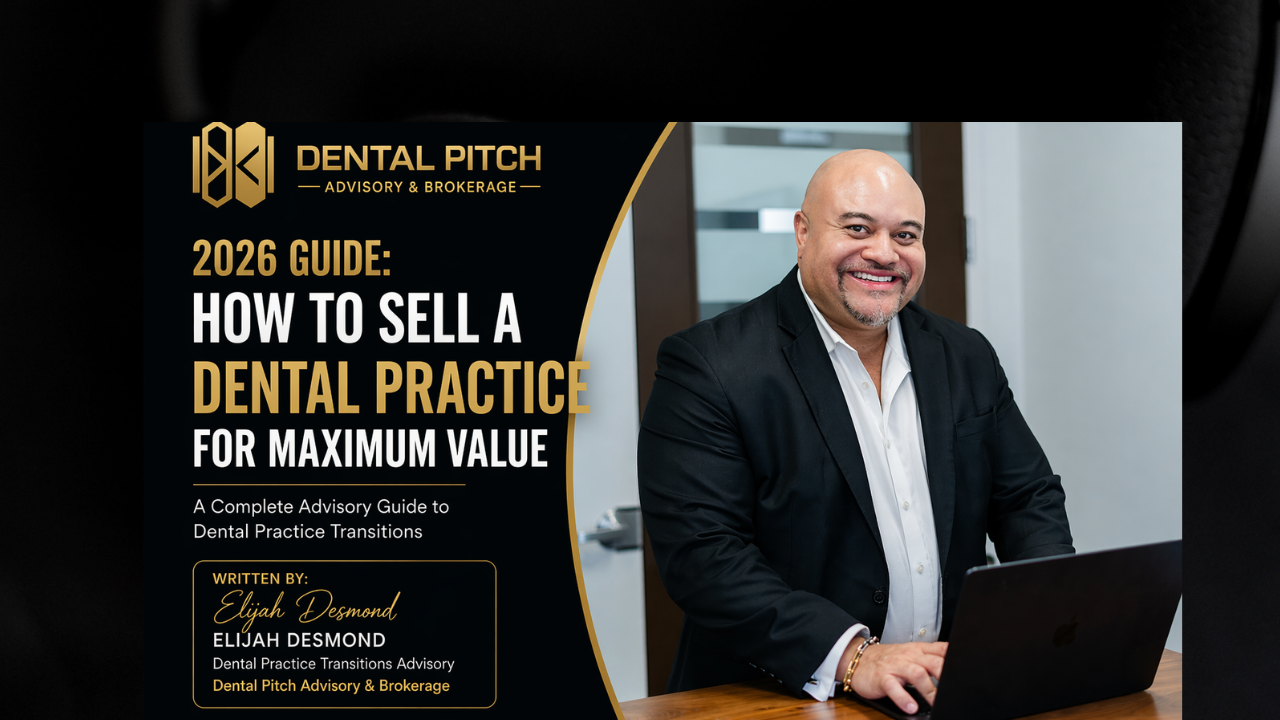
2026 Complete Guide: How to Sell a Dental Practice for Maximum Value
A Complete Advisory Guide to Dental Practice Transitions
By Elijah Desmond — Dental Practice Transitions Advisory, Dental Pitch Brokerage.
If you are searching how to sell a dental practice, you are likely trying to understand:
- →When is the right time to sell?
- →How much is my dental practice worth?
- →Should I sell to a DSO or another dentist?
- →What should I improve to sell for more money?
- →Can I stay on after the sale?
These are not just questions - they are the foundation of a successful dental practice transition. Before you explore the strategies in this 2026 guide, remember this: selling a dental practice for maximum value starts 3 to 5 years before going to market. The most valuable practices are built through stronger profitability, thoughtful fee reviews, efficient operations, and clean, organized financial records. Buyers place a premium on practices that show stability, efficiency, and clear financial performance..
What Does It Really Take to Sell a Dental Practice for Maximum Value?
Most dentists assume selling a dental practice is mostly about finding the right buyer at the right time. The reality is more specific than that.
The practices that sell for the most money in 2026 share three things in common: their financials are clean and validated, their EBITDA has been optimized before going to market, and they enter the buyer process with a team that knows how to create competitive tension among qualified buyers.
Timing matters. But preparation matters more.
The difference between an average sale and a premium outcome almost always comes down to what happened in the 12 to 36 months before the practice was ever listed. That is where EBITDA is improved, financials are organized, provider dependence is reduced, and the earnings story is built into something a sophisticated buyer cannot challenge.
That is exactly what Dental Pitch Brokerage is built to do. Where most brokers show up when you are ready to sell, Dental Pitch enters the process years earlier — helping dentists understand their value, strengthen their position, and go to market only when the timing and preparation align for the strongest possible outcome.
No upfront fees. No retainers. Dental Pitch is compensated only when your transaction closes successfully.
How to Sell a Dental Practice the Right Way
Selling a dental practice today is not just about finding a buyer.
It is about:
- →understanding your dental practice valuation
- →improving EBITDA before going to market
- →preparing your practice strategically
- →choosing the right buyer path
- →and running a structured, competitive process
The difference between an average outcome and a premium outcome is almost always preparation.
This is where dental practice transitions advisory becomes a major advantage.
Step 1: Understand Why You Are Selling
Before you sell your dental practice, you need clarity on your goals.
Your reason for selling influences:
- →timing
- →buyer type
- →deal structure
- →your role after the sale
Common Advisory Question
When is the right time to sell a dental practice?
The best time to sell is when your practice is stable, growing, and producing strong earnings. If you are even thinking about selling in the next 2–4 years, that is the time to start preparing.
— Elijah Desmond, Dental Pitch Advisory & Brokerage
Step 2: Understand Your Dental Practice Valuation Beyond the Basics
Most dentists start by asking what their practice is worth.
But buyers look deeper.
They evaluate:
- →EBITDA
- →consistency of earnings
- →risk profile
- →growth potential
A basic valuation gives you a number.
A stronger approach explains why that number holds up under scrutiny.
Common Advisory Question
How much is my dental practice worth?
Your practice is worth what a qualified buyer will pay based on your earnings, risk, and growth potential. The key is not just the number—it's how clearly that number is supported.
— Elijah Desmond, Dental Pitch Advisory & Brokerage
Step 3: Why EBITDA Drives Dental Practice Value
If you want to understand how to sell a dental practice for more money, you must understand EBITDA.
Buyers use EBITDA to:
- →compare practices
- →evaluate profitability
- →determine valuation multiples
Common Advisory Question
Why do buyers focus on EBITDA?
Because EBITDA reflects how the business actually performs. It allows buyers to compare practices consistently and evaluate true earnings power.
— Elijah Desmond, Dental Pitch Advisory & Brokerage
Step 4: Prepare Your Practice Before You Sell
If you want to sell your dental practice for maximum value, preparation is everything.
In advisory-driven dental practice transitions, real value is created before the practice ever goes to market.
Preparation includes:
- →cleaning up financials
- →improving operations
- →stabilizing your team
- →reducing risk
- →organizing documentation
A well-prepared practice:
— attracts better buyers
— sells faster
— supports higher offers
Common Advisory Question
How far in advance should I prepare to sell my dental practice?
Ideally 12–24 months. The earlier you start, the more opportunities you have to increase value and reduce risk.
— Elijah Desmond, Dental Pitch Advisory & Brokerage
Step 5: Selling a Dental Practice to a DSO vs Private Buyer
One of the biggest decisions in a dental practice transition is choosing the right buyer.
Selling to a Private Buyer:
- →simpler deals
- →continuity
- →culture alignment
Selling to a DSO:
- →potentially higher valuation
- →structured deals
- →growth platforms
Common Advisory Question
Should I sell my dental practice to a DSO?
It depends on your goals. DSOs can offer strong pricing for the right practice, but deal structure, autonomy, and long-term fit matter just as much as price.
— Elijah Desmond, Dental Pitch Advisory & Brokerage
Step 6: Choose the Right Dental Practice Transitions Advisory Team
This is one of the most important decisions in the entire process.
A true dental practice transitions advisory team does not just list your practice.
They help you:
- →prepare early
- →understand your value
- →improve EBITDA
- →position your practice strategically
- →create buyer competition
- →negotiate stronger deals
Common Advisory Question
Can the right advisor help me sell my dental practice for more money?
Yes. A structured advisory-led process often leads to stronger pricing, better terms, and a smoother transition.
— Elijah Desmond, Dental Pitch Advisory & Brokerage
Step 7: How to Sell a Dental Practice Step by Step (Going to Market)
Selling a dental practice is not about listing—it is about strategy.
A strong go-to-market process includes:
- →targeted buyer outreach
- →controlled information sharing
- →structured communication
- →competitive positioning
Common Advisory Question
How long does it take to sell a dental practice?
Most transactions take 6–12 months, depending on preparation, demand, and deal complexity.
— Elijah Desmond, Dental Pitch Advisory & Brokerage
Step 8: Evaluate Offers Beyond Price
The highest offer is not always the best offer.
You need to evaluate:
- →deal structure
- →risk
- →earnouts
- →post-sale role
Common Advisory Question
What is an earnout in a dental practice sale?
An earnout is a portion of the purchase price paid later based on performance. It can increase total value, but it also adds risk.
— Elijah Desmond, Dental Pitch Advisory & Brokerage
Step 9: Negotiate From a Position of Strength
Strong outcomes come from strong positioning.
Your leverage comes from:
- →preparation
- →clarity
- →multiple interested buyers
Common Advisory Question
How do I negotiate a better dental practice sale?
You don't start at negotiation—you build leverage through preparation, positioning, and competition.
— Elijah Desmond, Dental Pitch Advisory & Brokerage
Step 10: Close and Transition Smoothly
A successful dental practice transition protects:
- →your team
- →your patients
- →your reputation
Common Advisory Question
What happens after I sell my dental practice?
You may stay on, transition gradually, or exit. The best transition plans are built before closing, not after.
— Elijah Desmond, Dental Pitch Advisory & Brokerage
Why Working With a Dental Practice Transitions Advisory Team Changes the Outcome
Selling a dental practice without strategy often leads to:
- →lower offers
- →weaker terms
- →more risk
An advisory-driven approach focuses on:
- →preparation
- →positioning
- →buyer alignment
- →structured negotiation
In many cases, this leads to 20–40% stronger outcomes.
Final Thoughts on How to Sell a Dental Practice
Selling a dental practice is not just a transaction.
It is a dental practice transition that impacts your financial future, your team, and your legacy.
The dentists who achieve the best outcomes:
- →prepare early
- →understand EBITDA and valuation
- →choose the right buyer path
- →and work with a dental practice transitions advisory team
Ready to Start Your Dental Practice Transition?
Dental Pitch helps dentists:
- →understand their value
- →improve EBITDA
- →compare buyer options
- →position their practice
- →and sell for more money with better terms
Start with a Practice Value and Transition Strategy Conversation today.
Request a confidential review to determine whether your practice aligns with current buyer demand, timing, and structure.
Talk to a Dental Advisor